A pack, not a service · Instant download
Hand one file to your AI. Ten minutes later it stops starting from zero.
The file interviews you, eight questions, then writes all four of your project files filled in and tells you where to save them. Right now nothing is writing anything down, which is why every session re-explains itself and decisions you already made get quietly reversed. The fix is plain text files plus two habits.
One time
$49
Eleven files, including three diagrams. Downloaded the second you pay, and setup runs about ten minutes. Every future version included at the same link.
Buy now, $49Instant download, so all sales are final. Read the real sample first. It's a full page of the actual pack, not a teaser.
You've had this conversation before. Twice.
You explain the project. You get somewhere good. The window closes, or the model resets, or you start a new chat because the old one got slow. And the next session confidently rebuilds something you already decided against, in the same tone it used when it was right.
The usual advice is to write better prompts. That isn't it. A better prompt still starts from nothing, and you're the one paying the cost of remembering, every single time.
What actually works is boring and it's a filing system. One file that says what's true right now. One that says how the work runs. A dated log. And two habits at the start and end of a session that keep all three honest. That's the whole idea, and once it's running the difference is not subtle.
A real piece of the system
Two words that do most of the work.
The open and close habits, exactly as they run today. Everything else in the pack exists to make these two do something.
pick up
  Read the current-state file FIRST. Then the last two entries of the log, then
  the most recently changed decisions and tasks files. If the state file is older
  than the newest log entry, the log is the truth: reconcile before reporting
  anything. Then tell me, in this order: what we're doing, what changed recently,
  what's still open, what's waiting on someone else, and the best next move.
  Change nothing.

hand off
  Update the current-state file so it matches reality as of today and bump its
  date. Append a dated entry to the log. Update decisions and tasks. Re-read all
  of it from disk to confirm it saved. Never create a second status file. There
  is one, and it's the one you just updated.
The staleness rule inside `pick up` is the part people miss. Without it you eventually have two files disagreeing about what's true, and the confident one wins. That has cost more real time than any other bug in this system.
What's in it
Eleven files, and the system they describe is already running a real business.
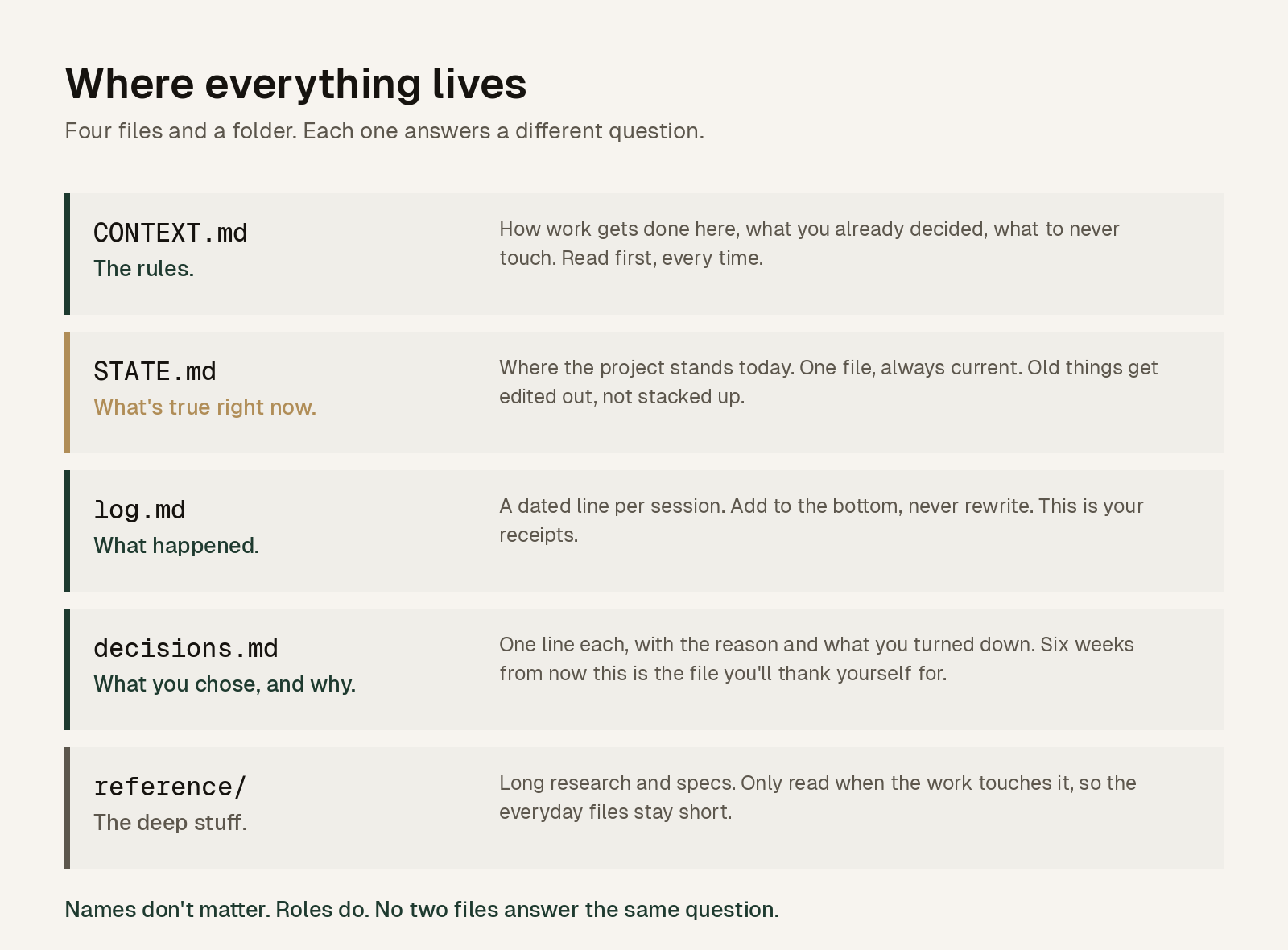
Hand this to your AI
One file that asks you eight questions, then writes all four of your project files filled in rather than blank, and tells you where to save them. About ten minutes.
The two habits
One prompt to open a session, one to close it, about two minutes a session. That's the part that turns a folder of files into memory that actually holds.
Plain markdown. It works with Claude, ChatGPT, Cursor, or anything that can read a file, and it keeps working when you switch tools, which is the actual point.
How it goes
An afternoon to set up, then about two minutes a session.
This isn't a productivity system you have to believe in. It's four files and two habits, and you'll know inside a week whether it's earning its keep.
Write down what's true
One file, the current state of the thing. Not history, not strategy, just what is true right now and what the next move is. Everything else in the system orbits this one file, and there is only ever one of it.
Write down how the work runs
The rules a session needs before it does anything: what it can decide on its own, what it must stop and ask about, and what's already settled and shouldn't be reopened. This is what stops a fresh session from relitigating a call you already made.
Open and close every session
Paste the open habit at the start, the close habit at the end. Two minutes total. That's the part that turns a pile of files into memory, and skipping it is how the whole thing rots.
What this doesn't do.
It doesn't make the model smarter and it won't stop it being confidently wrong. The model still doesn't know when it's wrong, and no filing system fixes that. What this changes is that it stops being wrong about things you already settled.
It also isn't a note-taking app or a second brain to admire. If it takes more than a couple of minutes a session, it's too big and it will be abandoned, which is covered honestly in the failure-modes file.
And it's not automatic. The habits are the system. Files nobody updates are just a slower way of forgetting.
Before you buy
The questions people actually ask.
$49, one time
Build it properly the first time.
Instant download, every future version included at the same link, and a real sample above so you know exactly what you're getting.